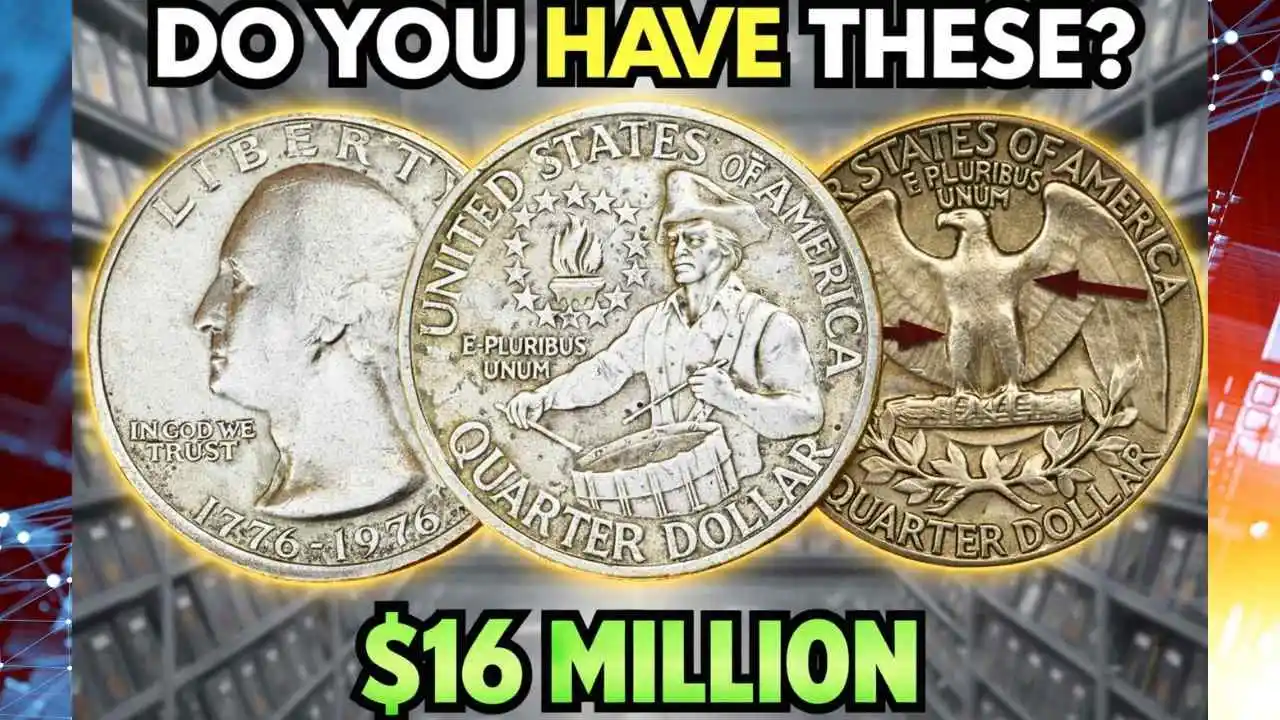
1776–1976 Bicentennial Quarter Value: Every so often, a coin tells a story far beyond its monetary value. The 1976 Bicentennial Quarter is one such piece—a tangible memento of America’s 200th birthday that still surfaces in everyday change. While sensational online tales sometimes suggest astronomical values, the true story of this coin is one of accessible history, the intrigue of collecting, and the genuine, though measured, potential for discovery. It connects us to a national celebration and invites a closer look at the ordinary objects we handle daily, transforming a simple quarter into a conversation with the past.
Born from a Nation’s Milestone
In the mid-1970s, as the United States prepared to mark its bicentennial, the U.S. Mint launched a special commemorative coin program. The quarter, half dollar, and dollar coins received temporary redesigns. For the quarter, the traditional eagle was set aside in favor of a stirring new reverse design by artist Jack L. Ahr. His depiction of a colonial drummer boy alongside a victory torch encircled by thirteen stars captured the revolutionary spirit of 1776. The obverse kept John Flanagan’s dignified portrait of George Washington but was updated with the iconic dual date “1776-1976.” This special design was produced throughout 1975 and 1976, making any quarter from those two years a bicentennial issue.
1976 Bicentennial Quarter: Key Facts & Figures
| Feature | Detail |
|---|---|
| Commemorative Dates | 1776-1976 (All coins from the program bear this dual date) |
| Obverse (Heads) Designer | John Flanagan |
| Reverse (Tails) Designer | Jack L. Ahr |
| Standard Metal Composition | Copper-Nickel Clad (Outer layers: 75% copper, 25% nickel; Core: 100% copper) |
| Collector Metal Composition | 40% Silver (Outer layers: 80% silver, 20% copper; Core: 20% silver, 80% copper) |
| Minting Facilities & Marks | Philadelphia (no mint mark or “P”), Denver (“D”), San Francisco (“S”) |
| Total Circulation Mintage | Approximately 1.6 billion combined from Philadelphia and Denver |
| Collector Versions | Proof coins (S Mint), Uncirculated Mint Sets, 40% Silver Proof & Uncirculated Sets |
| Typical Found-in-Pocket Value | $0.25 for a worn, copper-nickel coin |
What Actually Makes a Bicentennial Quarter Valuable?
It’s important to start with a realistic baseline: billions of these quarters were made, and the vast majority found in circulation are worth exactly 25 cents. Their value lies in their historical significance, not necessarily a high price tag. However, certain specific attributes can elevate a common quarter into a collectible. The primary factors are composition, condition, and errors. While most were struck in the standard copper-nickel “clad” metal, the Mint also produced a 40% silver version exclusively for collector sets. These silver coins, never intended for circulation, carry a premium due to their precious metal content and scarcity. Condition is everything in numismatics. A heavily worn, faded quarter has little extra value, but one preserved in mint, uncirculated state with sharp details and original luster can be desirable. Finally, minting errors—such as coins struck off-center, with double impressions, or missing the clad layer—are rare anomalies that can command significant interest from specialist collectors.
Your Handy Guide to Identifying a Special Quarter
If you’re inspired to check your own coins, here’s a simple, step-by-step approach:
- Examine the Edge: This is the fastest test. A regular copper-nickel quarter will show a distinct brown copper band sandwiched between silver-colored layers on its rim. A 40% silver Bicentennial Quarter will have a solid, uniform silver-gray edge with no copper stripe.
- Locate the Mint Mark: Look on the obverse (Washington’s head side) for a tiny letter just to the right of his ribbon. A “D” (Denver) or no mint mark (Philadelphia) indicates a standard circulation coin. An “S” (San Francisco) mint mark almost always signifies a coin struck for collectors, either as a proof or uncirculated specimen.
- Judge the Condition: Look closely at the high points of the drummer design—his arm, hand, and the torch. If these details are worn flat and blended into the field, the coin is well-circulated. If the details are razor-sharp and the surfaces have a consistent frosty or mirror-like finish with no scratches, it may be in collectible condition.
- Look for Unusual Features: Under good light, check for any obvious abnormalities, like a doubled image on the date or lettering, or a design that is dramatically stamped off-center. These error coins are exceptionally rare but highly prized.
The Real Reward: Connection and the Joy of the Hunt
The enduring appeal of the Bicentennial Quarter goes beyond dollars and cents. It serves as a perfect gateway into the world of coin collecting—a hobby that combines art appreciation, historical study, and the thrill of a potential find. The idea that a piece of history, or even a rare error, could be sitting in a drawer or a handful of change adds a layer of wonder to everyday life. It encourages mindfulness and connects us physically to a pivotal chapter in the American story, making history personal and tactile.
Frequently Asked Questions (FAQs)
Q: Is it true that a Bicentennial Quarter can be worth millions?
A: No, this is a common myth. While certain rare error coins or perfect-grade specimens can be valuable (sometimes in the thousands), there is no verified sale of any Bicentennial Quarter approaching one million dollars. The multi-million dollar stories are fabrications.
Q: I have a Bicentennial Quarter. What’s the first thing I should check?
A: First, look at the edge. A solid silver edge means it’s a 40% silver collector coin. A copper-striped edge means it’s the common copper-nickel version. Next, check the condition—sharp details and clean surfaces are key for any premium.
Q: What does an “S” mint mark mean on this quarter?
A: The “S” indicates it was struck at the San Francisco Mint. These coins were not released into general circulation; they were sold directly to collectors in special proof or uncirculated sets. A worn “S” quarter likely escaped from someone’s collection.
Q: Where can I get a professional opinion on my coin’s value?
A: For a definitive grade and authentication, consider services like the Professional Coin Grading Service (PCGS) or the Numismatic Guaranty Company (NGC). For a quick, informal assessment, a trusted local coin dealer can offer helpful guidance.
Q: Why are people still interested in such a common coin?
A: The interest stems from history, accessibility, and possibility. It’s a beloved piece of Americana, easy to find, and offers a starting point for collectors. The slim chance of finding a rare error or a pristine, high-grade example keeps the hunt exciting.
Q: Are all 1976 quarters Bicentennial quarters?
A: Yes. Any quarter dated 1976 (or bearing the dual date 1776-1976) is a Bicentennial quarter. The special design was produced for two full years, so there is no “regular” 1976 quarter.
